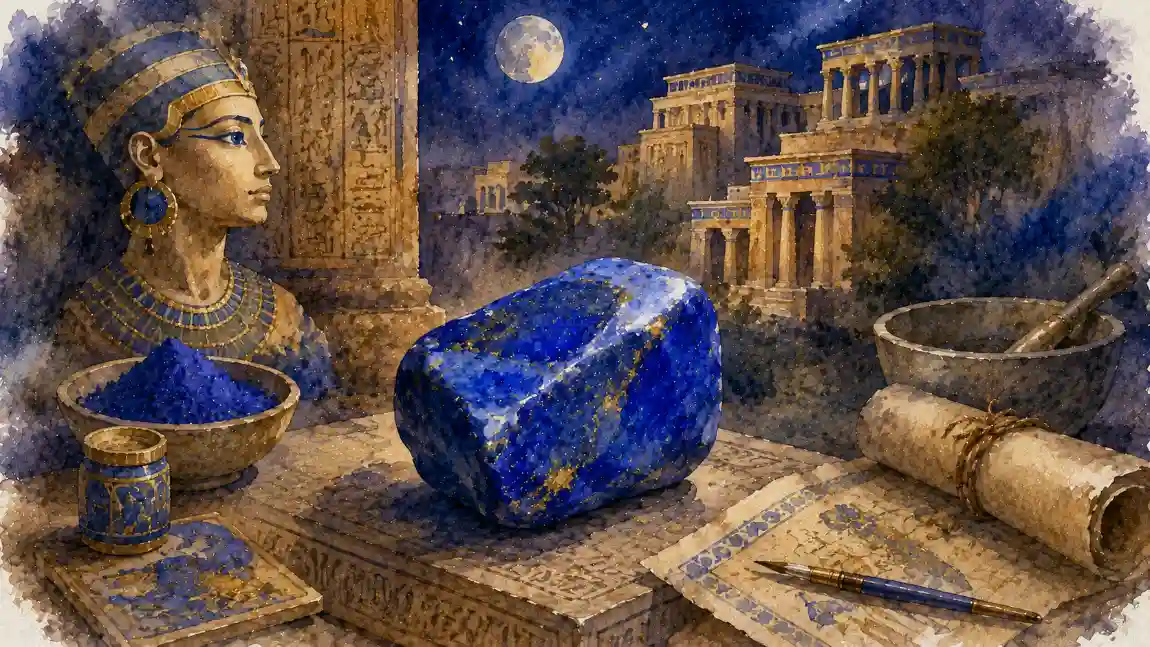
If there is one crystal that represents the meeting point of Shreyes Om's historical research and healing practice, it is lapis lazuli. It was lapis lazuli that first sparked his curiosity while researching ancient trade routes, and it remains one of the most significant crystals in Shreem Crystals protocols.
The most extraordinary trade in ancient history
Over 5,000 years ago, lapis lazuli was being mined in the mountains of what is now Afghanistan and transported across thousands of kilometres to the Indus Valley Civilisation and ancient Mesopotamia. This was one of the longest and most consistent trade routes in the ancient world - sustained not for food or weapons but for a single deep blue stone.
Lapis lazuli in ancient Egypt
The Egyptians used powdered lapis lazuli in their sacred eye makeup, believing it channelled divine wisdom. Lapis lazuli was found in the tomb of Tutankhamun and in the sacred regalia of pharaohs.
In ancient Egypt, lapis lazuli was more valuable than gold. They used it because they believed it was sacred.
Which chakra does it work with?
Lapis lazuli is primarily associated with the Ajna or Third Eye chakra and the Vishuddha or Throat chakra. It bridges these two energy centres, supporting both clarity of perception and the ability to communicate what is perceived with honesty and confidence.
What lapis lazuli supports
- Mental clarity and the ability to see situations clearly
- Honest, confident self-expression
- Intuition and inner wisdom
- Deep meditation and spiritual practice
Identifying genuine lapis lazuli
Genuine lapis lazuli is a deep royal blue with gold flecks of pyrite. Dyed howlite or sodalite is often sold as lapis lazuli in Indian markets. At Shreem Crystals, every lapis lazuli is personally verified by Shreyes Om before use.
Take the free 5-minute chakra consultation and receive a personalised crystal healing protocol.
Free Chakra Assessment